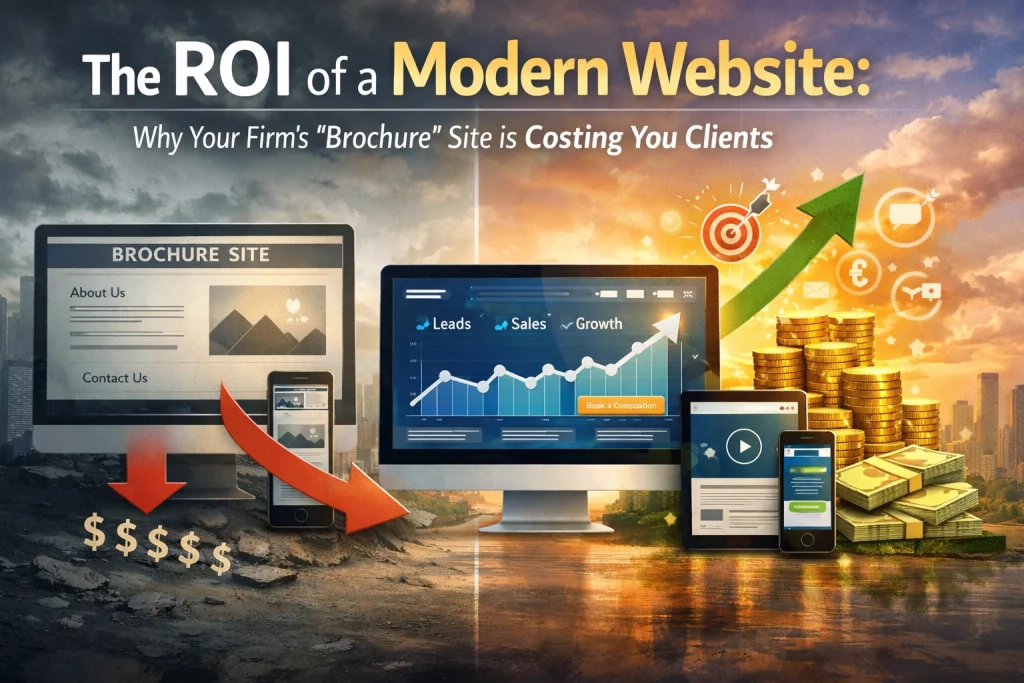
In the current digital landscape, your website is no longer just an online business card. For professional service firms: especially in high-stakes industries like accounting and law: your website is either a high-performing sales engine or a silent leak in your revenue bucket.
Many firms are still clinging to what we call "Brochure" sites. These are static, rarely updated, and focus entirely on "who we are" rather than "how we solve your problem." While these sites might look "clean," they are often invisible to search engines and frustrating for potential clients.
If your website isn't actively generating leads, it’s costing you money. Here is why the shift from a static brochure to a modern, conversion-focused powerhouse is the most profitable investment you can make this year.
A brochure website is exactly what it sounds like: a digital version of a printed flyer. It typically includes an "About Us" page, a list of services, and a "Contact Us" page that consists of a lonely email address or a generic phone number.
The problem? Professional services have changed. Clients no longer pick up the phone the moment they see a name. They research. They compare. They look for proof of authority. A brochure site provides none of this. It stays static for years, telling Google that your business isn't active, which tanks your search rankings.
When a potential client lands on a brochure site, they find a dead end. There is no clear path to engagement, no helpful resources, and no reason to return. In a competitive market, a static site is a signal to your prospects that your firm might be as outdated as your web design.

Unlike a brochure site, a conversion-focused website is designed with a specific goal in mind: turning a visitor into a qualified lead. For an accounting firm, this means moving beyond a list of services like "Tax Preparation" and "Audit Services."
A modern site uses a strategic framework to guide the user. It identifies the client’s pain points: such as "IRS Audit Stress" or "Inaccurate Cash Flow Forecasts": and presents your firm as the specific solution.
Key elements of a conversion-focused site include:
By focusing on the user’s journey, you transform your site from a static document into a 24/7 sales representative.
If your website doesn't appear on the first page of Google, you don't exist to 90% of your potential clients. Brochure sites are notorious for poor SEO (Search Engine Optimization). They often lack the technical structure and content depth required to rank for high-value keywords.
When you invest in a modern site, you aren't just paying for pretty pictures; you are paying for search visibility. A modern site is built on a foundation of strategic SEO, ensuring that when a local business owner searches for "Accountant near me" or "Business tax consultant," your firm is the first one they see.
Organic traffic is one of the most cost-effective ways to grow. While paid ads stop the moment you stop paying, a well-optimized, modern website continues to pull in leads month after month. Relying on an outdated site forces you to spend more on aggressive advertising just to make up for the lack of organic discovery.

In 2026, user experience (UX) is a primary ranking factor for search engines and a primary trust factor for humans. If your site takes more than three seconds to load, you’ve already lost half your audience.
Modern websites are optimized for speed and "Mobile-First" indexing. Since the majority of web traffic now happens on smartphones, your firm’s site must look and function perfectly on a 6-inch screen. Brochure sites are often plagued by "heavy" unoptimized images and old code that crawls on mobile devices.
A 1-second improvement in site speed can increase conversions by up to 7%. For a high-ticket professional service firm, that 7% could represent hundreds of thousands of dollars in annual billings. Beyond the numbers, a fast, sleek website communicates competence. If you can’t manage your own digital presence, a client may wonder how well you will manage their financial records or legal cases.

When we talk about the ROI of a website redesign at TX Digital Marketing, we look at two specific categories:
This is the data you can see in your dashboard. It includes:
This is the "compounding interest" of digital marketing:
The investment in a modern website typically pays for itself within months through improved conversion rates alone. If you are still running a brochure site, you aren't saving money: you are losing market share.

While a full redesign should happen every 2–3 years to keep up with technological standards, content should be updated weekly or monthly. A conversion-focused site requires ongoing optimization to stay ahead of the competition.
You can, but templates often come with "bloated" code that slows down your site and limits your ability to optimize for SEO. A custom, strategic design ensures your site is built specifically to convert your unique target audience.
If your site hasn't been updated in over a year, doesn't have a blog, lacks clear "Action" buttons on every page, and isn't generating at least a few leads every week, it’s likely a brochure site.
The first step is a comprehensive audit. You need to understand where your current site is failing: whether it's speed, SEO, or user experience. You can explore our portfolio to see how we’ve transformed other businesses.
At TX Digital Marketing, we specialize in moving firms away from "pretty but useless" websites and toward high-performance digital assets. We don't just build websites; we build growth engines.
If you’re ready to see what a modern, conversion-focused website can do for your bottom line, let’s talk.
Stay Ahead of the Competition
The digital landscape moves fast. Don't let your firm get left behind with an outdated "brochure" strategy. Subscribe to our newsletter for the latest insights on SEO, high-conversion design, and ROI-driven marketing tactics.
[SUBSCRIBE TO OUR NEWSLETTER]
TX Digital Marketing: Over a decade of helping professional services dominate their local markets through data-driven design and relentless optimization.
You came here for an answer. Book a meeting with Preston and get a straight answer about whether TX Digital Marketing can help. If there is not a real path to improve leads, sales, or return, you do not pay for a pretend plan.
Book a meeting