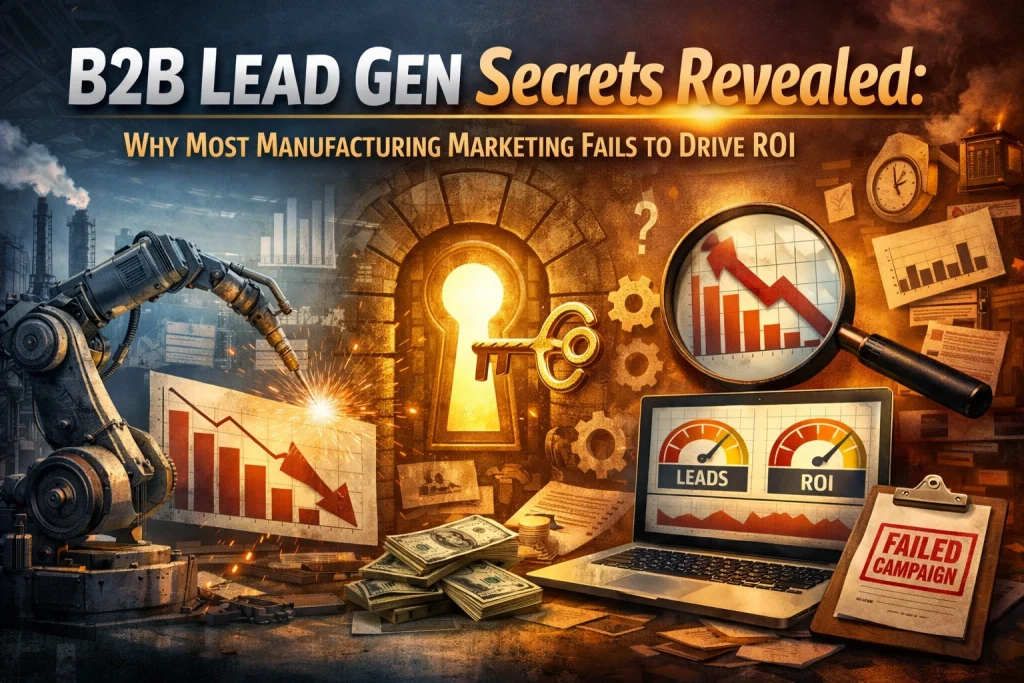
For many manufacturing CEOs and plant managers, marketing often feels like a black hole. You pour money into trade shows, glossy brochures, and maybe a few Google Ads, only to wonder why the phone isn't ringing with high-value contracts.
The manufacturing sector operates on long sales cycles, technical specifications, and high-trust relationships. Yet, most marketing agencies try to apply "fast-fashion" B2C tactics to a heavy industry environment. The result? A lot of "fluff" metrics: like impressions and clicks: but zero impact on the bottom line.
At TX Digital Marketing, we’ve seen where the gears grind to a halt. In this deep dive, we’re revealing the core reasons why traditional manufacturing marketing fails and how to pivot toward a strategy that actually drives ROI.
Table of Contents
- The Trade Show Black Hole: Why 80% of Investment is Wasted
- The Silo Trap: Why Your Sales and Marketing Aren't Talking
- Quality Over Quantity: The Account-Based Marketing (ABM) Shift
- Technical SEO: Capturing the High-Intent Engineer
- Leveraging Automation for Long-Cycle Nurturing
- Frequently Asked Questions
1. The Trade Show Black Hole: Why 80% of Investment is Wasted
For decades, trade shows were the lifeblood of manufacturing lead generation. You show up, display the new CNC machine or the latest polymer solution, collect business cards, and go home.
Research shows that manufacturers often waste 70–80% of their trade show investment. Why? Because the follow-up is non-existent or handled manually months later. A lead collected on a Tuesday is cold by Friday if they haven't received a digital touchpoint.
The secret to ROI isn't the booth; it's the digital ecosystem surrounding it. Successful manufacturers treat trade shows as a catalyst for inbound marketing. By creating dedicated landing pages and using QR codes to funnel prospects directly into a CRM, you ensure that no lead falls through the cracks.

2. The Silo Trap: Why Your Sales and Marketing Aren't Talking
One of the biggest reasons marketing fails to drive ROI in manufacturing is the disconnect between the marketing team and the sales floor. Marketing is focused on "leads" (anyone who downloads a PDF), while Sales is focused on "deals" (qualified RFQs).
If your marketing team doesn't understand the technical nuances of your product, they will attract the wrong audience. This leads to Sales ignoring marketing leads entirely, creating a cycle of wasted spend.
To bridge this gap, you need a unified lead scoring system. Instead of counting every download as a win, we look at behavioral data. Did they visit the pricing page? Have they looked at technical spec sheets multiple times? By integrating your CRM with your digital efforts, you can prioritize the 5% of leads that are actually ready to talk to an engineer.
If you want to see how we’ve helped other businesses bridge this gap, check out our portfolio of success stories.
3. Quality Over Quantity: The Account-Based Marketing (ABM) Shift
In manufacturing, you don't need 10,000 random visitors. You need 10 specific procurement officers at Tier-1 automotive suppliers.
Traditional marketing is "spray and pray." Account-Based Marketing (ABM) is a sniper rifle. Most manufacturing marketing fails because it tries to appeal to everyone. ROI is found when you identify your "Whale Accounts" and create content specifically for them.
This involves:
- LinkedIn Targeting: Reaching specific job titles (e.g., "Director of Operations") at specific companies.
- Personalized Content: Creating case studies that solve the exact pain points of a specific industry vertical.
- Direct Outreach Integration: Aligning your digital ads with your sales team's cold calls.

4. Technical SEO: Capturing the High-Intent Engineer
When an engineer is looking for a solution to a production bottleneck, they don't go to Facebook. They go to Google. They search for specific part numbers, tolerances, or material properties.
If your website isn't optimized for these "long-tail" technical terms, you are invisible. Most manufacturers have "brochure-ware" sites that look nice but lack the structural SEO to rank for technical queries.
High-ROI marketing requires a deep dive into SEO services that prioritize technical authority. This means building out comprehensive resource libraries, CAD file downloads, and white papers that position your brand as the expert in the field.
For instance, we’ve seen massive success when manufacturers move away from generic keywords like "metal parts" and focus on "ISO 9001 certified aerospace aluminum machining." The volume is lower, but the intent: and the ROI: is significantly higher.
5. Leveraging Automation for Long-Cycle Nurturing
The average manufacturing sales cycle can range from six months to two years. Most marketing fails because it stops after the initial contact.
ROI is built in the "nurture" phase. Automated email sequences that provide value: rather than just "checking in": keep your brand top-of-mind. Whether it’s sharing a new blog post about Shopify growth for your B2B distributors or sending a technical update about industry regulations, automation ensures you are there when the prospect is finally ready to buy.

Case Study Logic: Turning Traffic into Tonnage
Consider a mid-sized plastics manufacturer we analyzed. They were spending $5,000 a month on generic Google Ads. They got plenty of clicks, but the leads were small-scale hobbyists, not the industrial contracts they needed.
By shifting their strategy to focus on high-intent SEO and LinkedIn ABM, we reduced their total lead volume by 40%, but increased their Sales Qualified Leads (SQLs) by 300%. The cost per lead went up, but the ROI skyrocketed because the sales team was finally closing million-dollar contracts instead of chasing $500 orders.
Frequently Asked Questions
Why isn't my website generating RFQs?
Most manufacturing websites are designed as digital brochures rather than lead-generation machines. To generate RFQs, you need clear CTAs, technical value-adds (like spec sheets), and a modern website design that builds immediate trust.
How long does it take to see ROI from manufacturing marketing?
Because of the long sales cycles, you should expect to see leading indicators (increased high-quality inquiries) within 3-6 months, with actual revenue ROI manifesting between 6-12 months.
Is AI useful for manufacturing marketing?
Absolutely. AI can help in predicting lead behavior and scaling technical content creation. We’ve explored how tools like Jarvis AI can transform content workflows, allowing you to produce high-quality technical guides in a fraction of the time.

Stop Guessing and Start Growing
The manufacturing landscape is more competitive than ever. If your marketing strategy is still stuck in 2015, you are leaving millions on the table. At TX Digital Marketing, we specialize in cutting through the noise and delivering measurable results for industrial and B2B brands.
Ready to overhaul your lead generation and start driving actual ROI? Contact TX Digital Marketing today to schedule a strategy session.
Stay Ahead of the Competition
Don't let your competitors outpace you in the digital landscape. Subscribe to our newsletter for the latest insights on SEO, B2B lead generation, and digital marketing strategies designed specifically for the manufacturing sector.
TX Digital Marketing: Over a decade of experience helping businesses scale through data-driven marketing.